
What-is-artificial-intelligence?
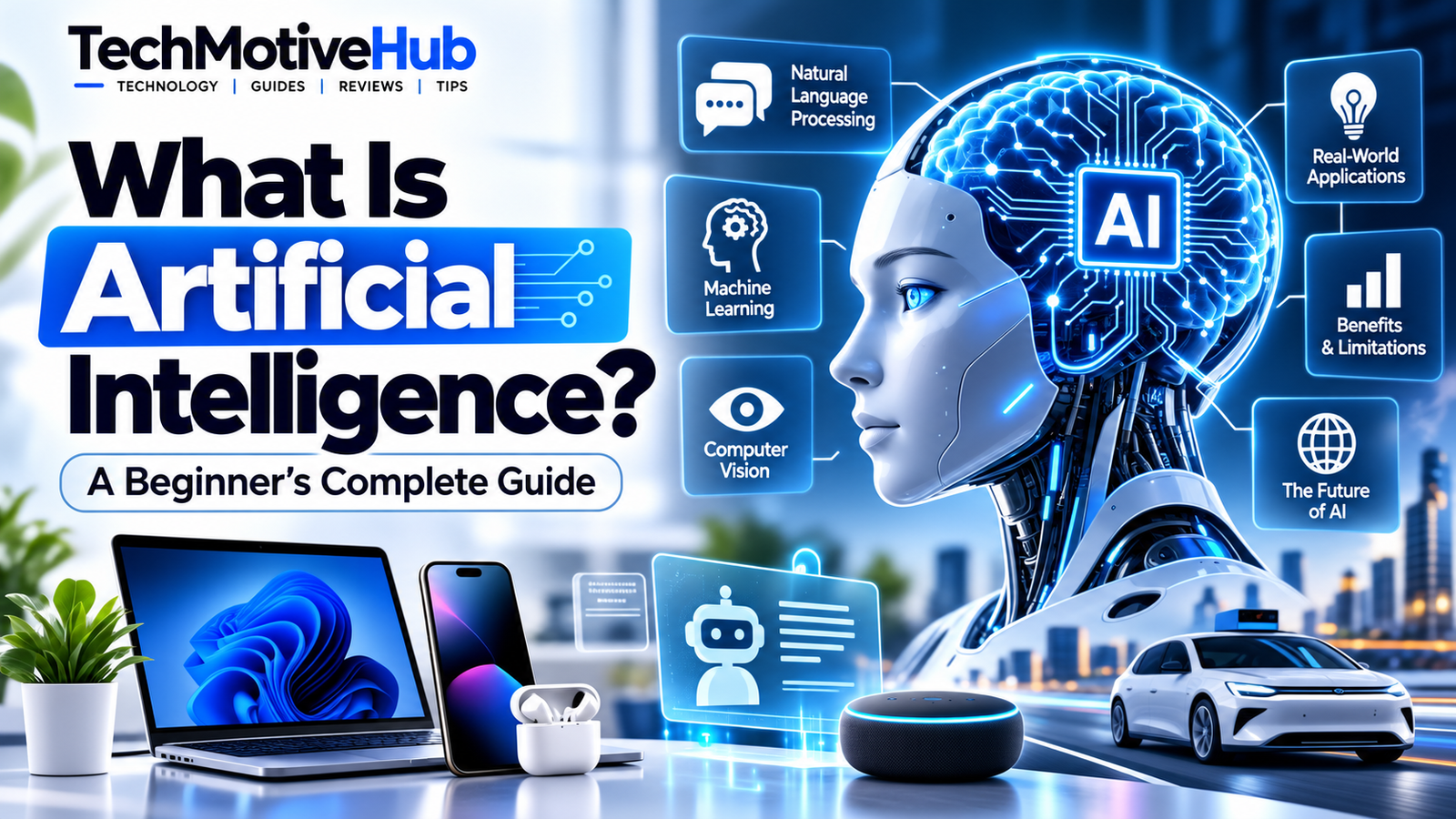
Artificial Intelligence, or AI for short, has turned into one of the most talked-about technologies of our time. It’s in our smartphones and search engines, in chatbots and recommendation systems, in smart cars and image-generation tools. Slowly but surely, it’s becoming part of everyday life.
But what is artificial intelligence, exactly?
Put simply, artificial intelligence is technology that lets computers and machines do tasks that normally need a bit of human intelligence. Those tasks include understanding language, recognizing images, spotting patterns, making predictions, solving problems, learning from information, and creating new content.
Chances are you’re already using AI without realizing it. When your phone unlocks with your face, a streaming app suggests a movie, your email filters out spam, or a chatbot answers a question, AI may be quietly doing the work in the background.
This beginner’s guide explains what is artificial intelligence, how it works, the different types of AI, where it’s used, what it does well, where it falls short, and what its future might look like.
What Does Artificial Intelligence Mean?
The term combines two simple ideas: “artificial” and “intelligence.”
Artificial means something made by humans rather than something that occurs naturally.
Intelligence usually means the ability to learn, understand information, notice patterns, solve problems, and make decisions.
So artificial intelligence describes computer systems built to handle tasks that involve abilities we normally link to human intelligence.
That said, AI doesn’t necessarily think or understand the world the way a person does. Most of today’s AI systems are specialized tools built for particular jobs, running on algorithms, data, and computing power.
For instance, an AI system that recognizes faces can’t suddenly write you an article. A language model can write text, but that doesn’t mean it can drive a car without extra systems to help it.
Keeping this difference in mind matters when you’re learning what is artificial intelligence and what AI can really do.
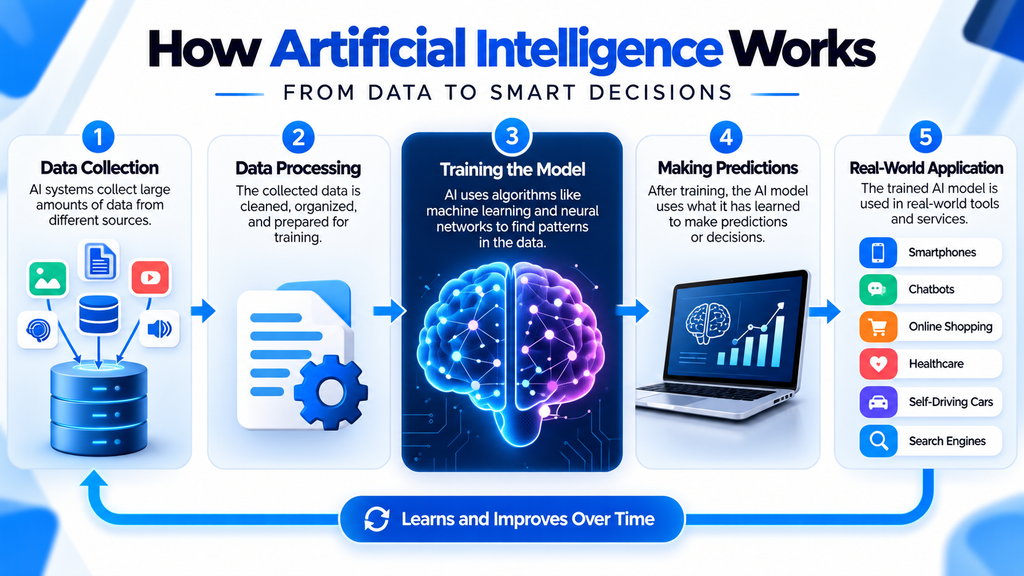
How Does Artificial Intelligence Work?
A good way to get a feel for AI is to think about how people learn from examples.
Picture showing a child thousands of photos of cats and dogs. After a while, the child starts to pick up the differences between them.
AI systems can also learn patterns from huge amounts of information, even though the technical process is very different from how a human learns.
Modern AI can draw on a number of technologies and techniques, including:
Algorithms
Machine learning
Neural networks
Deep learning
Natural language processing
Computer vision
Large datasets
High-performance computing
An AI model is trained on data so it can find patterns or relationships. Once it’s trained, it can take what it has learned, look at new information, and produce an output.
Take an image-recognition system. It might be trained on thousands or even millions of labeled pictures. After that, it can look at a brand-new image and estimate which objects or patterns are in it.
The exact process differs a lot from one AI system to the next.
What Is Machine Learning?
Machine learning is one of the most important ideas connected to artificial intelligence.
It lets computer systems learn patterns from data, so humans don’t have to hand-code every possible instruction.
Say a company wants to catch spam emails. Writing a rule for every possible spam message would be impossible. Instead, developers can train a machine-learning system on examples of spam and legitimate emails.
The system picks up the patterns that go with spam and uses them whenever a new message arrives.
Machine learning can be used for:
Recommendations
Fraud detection
Image recognition
Spam filtering
Predictive analysis
Search systems
Voice recognition
Personalized content
That’s why machine learning is such a big piece of understanding what is artificial intelligence and how so many AI-powered services actually run.
What Is Deep Learning?
Deep learning is a specialized branch of machine learning that uses artificial neural networks with many layers.
These networks are loosely inspired by how biological nervous systems are organized, but they are mathematical and computational systems, not artificial copies of the human brain.
Deep learning has driven major progress in areas like:
Image recognition
Speech recognition
Natural language processing
Generative AI
Autonomous systems
Video analysis
With enough data and powerful computing, deep-learning models can learn to spot more and more complex patterns.
What Are Neural Networks?
Artificial neural networks are computational models that pass information through connected layers.
A simplified neural network may include:
An input layer
One or more processing layers
An output layer
The system moves information through these layers and tweaks its internal settings as it trains.
For example, a network built to recognize handwritten digits could take an image as input and predict which number is written in it.
Modern neural networks can be enormous and very complex, especially in advanced AI systems.
Types of Artificial Intelligence
When you’re exploring what is artificial intelligence, it helps to know that AI can be sorted into categories in several ways.
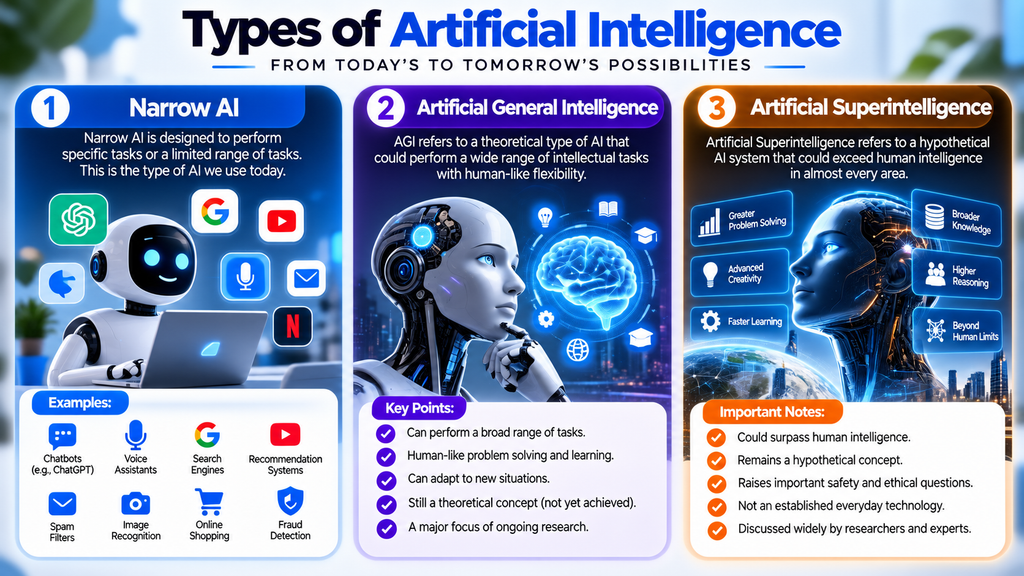
One common way splits it into narrow AI, artificial general intelligence, and artificial superintelligence.
1. Narrow Artificial Intelligence
Narrow AI, sometimes called weak AI, means systems built to do specific tasks or a small range of tasks.
Almost all the AI we use in daily life today belongs here.
Examples include:
Voice assistants
Recommendation systems
Spam filters
Image-recognition systems
Translation tools
AI writing tools
Search algorithms
Fraud detection systems
A narrow AI system can be extremely good at its one job without having anything like general human intelligence.
2. Artificial General Intelligence
Artificial General Intelligence, or AGI, is a theoretical kind of AI that could handle a wide range of intellectual tasks with flexibility similar to a human’s.
It would differ from today’s specialized systems because it wouldn’t be tied to one particular task.
Researchers and organizations define AGI in different ways, and there’s no single test that everyone agrees can prove an AI system has reached it.
For beginners, the main idea is this: AGI means general-purpose intelligence, not a system made mainly for one specific job.
3. Artificial Superintelligence
Artificial Superintelligence is a hypothetical idea: an AI whose intellectual abilities would go far beyond those of humans across a wide range of areas.
For now, it remains a theory, not an everyday technology.
Conversations about superintelligence often raise questions about safety, control, governance, economic change, and where AI development may head in the long run.
What Is Generative AI?
Generative AI is another major area of artificial intelligence.
Rather than just sorting or analyzing information that already exists, generative AI systems can create new content based on patterns they learned during training.
Depending on the system, generative AI can produce:
Text
Images
Audio
Video
Computer code
Summaries
Translations
Other digital content
AI chatbots and AI image generators are well-known examples.
For instance, you can type a prompt describing a picture, and a generative AI system may create an image from your description.
In the same way, you can ask a language model a question and it will write out an answer.
What Is Natural Language Processing?
Natural Language Processing, or NLP, is the part of AI that helps computers work with human language.
Language is tricky because the same word can mean different things depending on the context.
NLP technologies can be used for:
Chatbots
Translation
Text summarization
Speech-to-text systems
Text classification
Search
Sentiment analysis
Writing assistance
When you type a question into an AI chatbot and get a natural-sounding reply, NLP and related AI technologies are probably involved.
What Is Computer Vision?
Computer vision is the area of artificial intelligence that helps computers analyze and make sense of visual information.
It can work with input from:
Photographs
Videos
Cameras
Scanned documents
Medical images
Other visual sources
Examples include object detection, facial recognition, image classification, optical character recognition, and visual inspection systems.
Computer vision shows up in many industries, including manufacturing, healthcare, transportation, retail, security, and consumer technology.
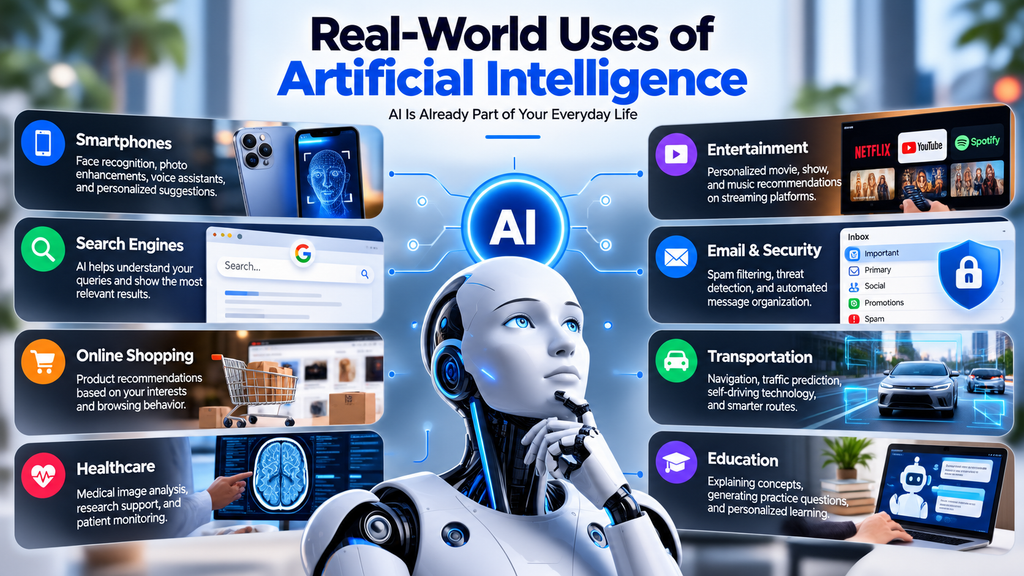
How Is Artificial Intelligence Used in Everyday Life?
You don’t have to work at a tech company to run into AI.
It’s already built into plenty of the digital products and services we use.
Smartphones
Modern smartphones can use AI for:
Face recognition
Camera improvements
Voice features
Photo organization
Keyboard predictions
Battery optimization
Translation
Personalized suggestions
Search Engines
Search systems rely on advanced algorithms and machine learning to understand what you’re asking and sort out the most relevant information.
Streaming Services
Entertainment platforms can study what you watch and use recommendation systems to suggest movies, shows, songs, or other content.
AI and machine learning can help spot spam, sort messages into categories, and flag suspicious activity.
Social Media
Social platforms can use algorithms and AI-related technologies to recommend posts, videos, accounts, and other content.
Online Shopping
E-commerce platforms can use recommendation systems to suggest products based on your browsing, searches, purchases, and other signals.
Artificial Intelligence in Healthcare
AI is also being explored and used in many healthcare-related areas.
Possible applications include:
Medical image analysis
Research assistance
Administrative automation
Drug discovery research
Patient monitoring
Data analysis
Clinical decision-support tools
Healthcare, though, is a high-stakes field. AI-generated information shouldn’t automatically be treated as medical advice, and professional oversight still matters whenever health decisions are involved.
How useful and reliable an AI system is can also depend on how it was designed, what data it was trained on, how it was validated, and what it was meant for.
Artificial Intelligence in Education
AI can also support learning and education.
Students and teachers may use AI tools for:
Explaining difficult concepts
Generating practice questions
Summarizing information
Language assistance
Brainstorming
Personalized learning activities
Writing feedback
Research assistance
Students should still use AI responsibly, though. AI-generated information can contain mistakes, and schools and universities may have their own rules about AI-assisted work.
AI can be a great learning aid, but it shouldn’t replace critical thinking or real understanding.
Artificial Intelligence in Business
More and more businesses are exploring AI for different jobs.
Possible business uses include:
Customer support
Data analysis
Marketing assistance
Document processing
Software development
Fraud detection
Workflow automation
Forecasting
Content creation
For many companies, a big draw is that AI can work through huge amounts of information and automate repetitive tasks.
At the same time, organizations have to think about privacy, security, accuracy, compliance, cost, and human oversight when they bring AI into their work.
Benefits of Artificial Intelligence
Understanding what is artificial intelligence also means understanding why individuals and organizations are so interested in it.
1. Automation
AI can take over repetitive tasks, freeing people up for work that needs creativity, judgment, communication, or other human strengths.
2. Faster Data Analysis
AI systems can get through large amounts of data far faster than a person could by hand.
3. Personalization
AI-powered recommendation systems can offer suggestions that fit your behavior and preferences.
4. Accessibility
AI supports accessibility through tools like speech recognition, text-to-speech, automatic captions, translation, and other assistive technologies.
5. Productivity
AI tools can help you draft documents, summarize information, organize ideas, generate code, and handle many other tasks.
6. Research and Innovation
Researchers can use AI to analyze data, find patterns, explore possibilities, and support scientific and technological progress.
Limitations of Artificial Intelligence
AI is powerful, but it isn’t perfect.
Knowing its limits matters just as much as knowing what it can do.
AI Can Make Mistakes
AI systems can give wrong information. Sometimes a model produces an answer that sounds convincing but is simply incorrect.
Always verify anything important.
AI Depends on Data
The quality and nature of the training and input data can shape an AI system’s results.
Poor, incomplete, biased, or unsuitable data can lead to problematic outputs.
AI Doesn’t Always Understand Context Like Humans
Even advanced AI can misread vague questions, cultural context, sarcasm, or situations that need real-world judgment.
Privacy Concerns
Some AI applications handle huge amounts of information, which raises real questions about data collection, storage, privacy, and security.
Before you share sensitive data, make sure you understand how the AI service treats your information.
AI Can Be Misused
As with many technologies, AI can be used for good or for harm.
Misuse can include creating deceptive content, automated scams, impersonation, misinformation, and other harmful activities.
Is Artificial Intelligence Replacing Humans?
A common question people ask after learning what is artificial intelligence is whether AI will replace human workers.
There’s no single answer that fits every job.
AI can automate certain tasks, but many jobs combine several responsibilities, such as talking with people, physical work, judgment, creativity, accountability, or specialized knowledge.
In many cases, AI is more likely to change how people do their jobs than to wipe out a whole occupation.
A writer might use AI to brainstorm ideas, a programmer might use AI-assisted coding tools, and a customer-support worker might use AI to find answers faster.
The effects of AI on employment can look very different across industries, occupations, organizations, and time periods.
AI and Human Intelligence
Artificial intelligence and human intelligence are not the same thing.
Humans have physical experiences, emotions, social relationships, consciousness, and biological needs, and we learn from everyday life in ways that are fundamentally different from today’s AI systems.
AI works through computational processes, models, algorithms, and data.
An AI can be outstanding at one particular task while lacking many of the broader abilities people use naturally every day.
That’s why we shouldn’t assume a system that writes impressive text, images, or code must have human-like understanding in every area.
How Can Beginners Start Learning About AI?
If you’re new to artificial intelligence, you don’t need to become a computer scientist overnight.
A good place to begin is with the basic concepts:
Understand what AI means.
Learn the difference between AI and machine learning.
Explore basic concepts such as neural networks.
Learn what generative AI means.
Experiment with responsible AI tools.
Learn about AI limitations.
Explore basic programming if you want to build AI systems.
Follow reliable technology and research sources.
Practice verifying AI-generated information.
Learn about privacy and responsible AI use.
The most important thing is to stay curious and understand both what the technology can do and where it falls short.
What Is the Future of Artificial Intelligence?
The future of artificial intelligence will likely bring continued progress across many areas of technology.
AI research may help improve:
Software development
Robotics
Education
Healthcare
Scientific research
Transportation
Manufacturing
Cybersecurity
Creative tools
Personal productivity
Accessibility
At the same time, AI’s growth raises serious questions about privacy, security, intellectual property, employment, misinformation, safety, transparency, and responsible use.
So the future of AI will depend not just on technical progress, but also on the choices that individuals, businesses, researchers, and governments make about how to build and use these systems.
Frequently Asked Questions About Artificial Intelligence
What is artificial intelligence in simple words?
Artificial intelligence is technology that lets computer systems do tasks linked to human intelligence, like recognizing patterns, understanding language, making predictions, analyzing information, and creating content.
Is AI the same as machine learning?
No. Machine learning is one part of artificial intelligence. Machine-learning systems learn patterns from data and use them to complete tasks or make predictions.
Is ChatGPT artificial intelligence?
Yes. ChatGPT is an AI-based conversational system that uses language-model technology to respond to user prompts.
Is artificial intelligence safe?
It depends on the specific system, how it’s designed, how it’s used, and which safeguards are in place. AI offers useful capabilities, but it can also make errors or be misused.
Can AI think like a human?
Today’s AI can handle many tasks we associate with intelligence, but it doesn’t work like a human brain. It runs on computational models, algorithms, and data.
Where is AI used?
AI is used in many places, including smartphones, search, entertainment, online shopping, cybersecurity, healthcare research, education, business software, transportation, and content-generation tools.
Will AI replace every job?
There’s no basis for claiming AI will replace every job. It can automate some tasks and change how work gets done, but many jobs depend on broader human skills and judgment.
Why is artificial intelligence important?
It matters because it can automate tasks, analyze large amounts of information, boost productivity, power new digital tools, and contribute to research and innovation.
Final Thoughts
So, what is artificial intelligence?
It’s a broad field of technology focused on building computer systems that can handle tasks we usually connect with intelligence, including pattern recognition, language processing, prediction, problem-solving, and content generation.
From smartphones and search engines to AI chatbots and recommendation systems, artificial intelligence is already part of many people’s daily digital lives.
But AI isn’t perfect. It can make mistakes, share inaccurate information, create privacy concerns, and be misused. Understanding these limits is just as important as learning what it can do.
For beginners, the best approach is to stay curious, experiment responsibly, verify important information, and keep learning as the technology develops.
As artificial intelligence keeps evolving, getting the basics right today will help you make sense of the digital tools and technologies that will shape tomorrow.
TechMotiveHub will keep covering technology, AI, digital tools, guides, reviews, and useful tips to help readers make sense of a fast-changing tech world.
